Trends in Alternative Fuel Technologies for Environmentally-Friendly Ships
Body

As the International Maritime Organization (IMO) introduces and continuously strengthens regulations to reduce greenhouse gas (GHG) emissions from international shipping, decarbonization technologies for environmentally-friendly ships have become essential for the survival of the maritime and shipbuilding industries. This article presents the rapidly evolving alternative fuel technologies for ships and highlights key issues.
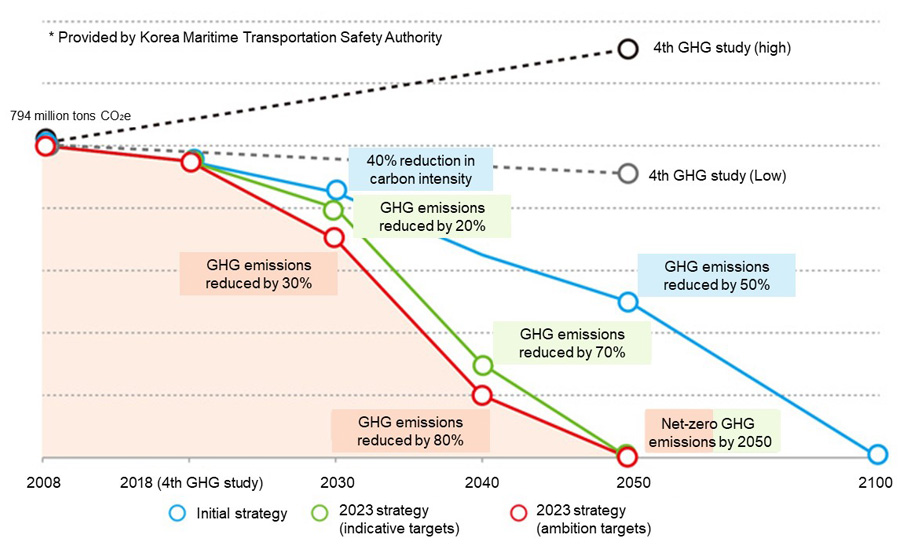
2023 IMO Strategy on Reduction of GHG Emissions from Ships (2023 IMO GHG Strategy)
The International Maritime Organization (IMO) is a specialized UN agency that addresses legal, environmental, and safety matters related to ships operating on the high seas. In 2023, the IMO adopted the 2023 IMO GHG Strategy, significantly raising its target to achieving net-zero emissions by 2050 [1]. Various GHG-related regulations such as the Energy Efficiency Design Index (EEDI) and Carbon Intensity Indicator (CII) have already taken effect, and discussions are now underway for even stricter regulations. As a result, the future viability of fossil-fuel-based ships is uncertain, and the shipbuilding and maritime sectors are experiencing unprecedented disruption.
Status of Eco-Friendly Alternative Marine Fuels
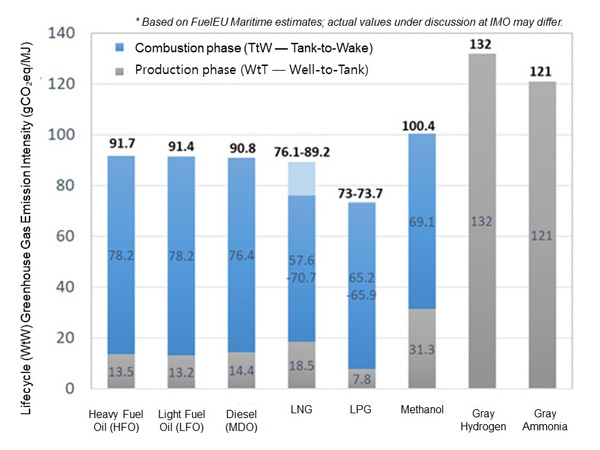
To move away from carbon-based fossil fuels, active discussions are ongoing regarding eco-friendly alternative fuels such as hydrogen, ammonia, biofuels, and e-fuels. Conventionally, GHG emissions from alternative fuels were evaluated base on a Tank-to-Wake (TtW) approach that accounted only for emissions during combustion. However, now the paradime is shifting toward assessing Well-to-Wake (WtW) GHG emissions based on Life-Cycle Assessment (LCA), which evaluates GHG upstream production through end-use. This shift implies that gray hydrogen or gray ammonia produced from fossil fuels will not be recognized as eco-friendly, and only green hydrogen (derived from renewable energy) or blue hydrogen (coupled with carbon capture, utilization, and storage—CCUS) will qualify as alternative fuels.
To use hydrogen for ships, research is advancing on hydrogen fuel cells for auxiliary propulsion and liquefied hydrogen carriers. However, challenges remain: Fuel cells must be scaled efficiently to meet ship power demands in the tens of megawatts. Liquefied hydrogen requires storage at -253°C, demanding advanced vacuum-insulated cryogenic tanks with significantly improved thermal insulation performance.
Ammonia-fueled engines are nearing commercialization, and its storage temperature (-33°C at atmospheric pressure) makes it easier to handle compared to hydrogen. However, due to its high toxicity (fatal at concentrations of a few hundred ppm), enhanced technologies for leak prevention and slip mitigation are essential.
Demonstration projects using bio-marine fuels are underway. However, when indirect land-use change (LUC) is considered, many studies show that biofuels may offer little or no advantage over fossil fuels in GHG emissions. IMO's interim guideline on biofuels states that biofuels should have WtW GHG intenstiy satisfying a reduction of at leats 65% of GHG intenstiy compared fossil fuels. This implies that biofuels from non-food crops or waste-derived feedstocks will be necessary for future acceptance as eco-friendly marine fuels.
Synthetic eco-friendly fuel technologies such as e-fuels are also receiving significant attention; however, because they must be synthesized using green hydrogen and renewable carbon dioxide, their application is expected to be feasible only after low-cost green hydrogen becomes commercially available and reliable sources of renewable CO₂ for capture are secured.
Status of Onboard Carbon Capture and Storage (OCCS) Technologies
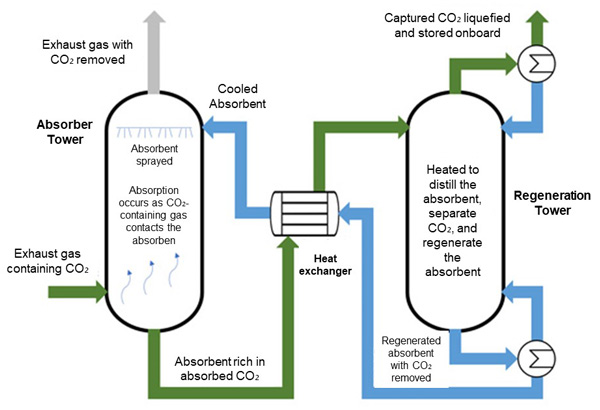
Given that the large-scale adoption of alternative marine fuels is unlikely in the near term, considerable attention has shifted toward Onboard Carbon Capture and Storage (OCCS)—an approach that adapts established Carbon Capture, Utilization, and Storage (CCUS) technologies for maritime applications. Among the various CCUS methods, chemical absorption-based post-combustion capture is currently considered as the most viable option for ships, as it can be integrated with minimal modification to existing propulsion systems.
However, unlike land-based facilities, OCCS systems must operate in a maritime environment characterized by continuous vessel motion, which introduces significant engineering challenges. Additional constraints include height limitations on absorber and stripper columns due to radar interference, restricted onboard space for equipment installation and CO₂ storage, and increased operational costs stemming from the relatively low CO₂ concentrations in exhaust gas from ships. Although the IMO has not yet established regulations governing OCCS, related discussions are ongoing within the MEPC, and the development of a regulatory framework is anticipated in the near future [4].
Moreover, even if CO₂ is successfully captured and stored onboard, practical deployment of OCCS will remain difficult in the absence of supporting infrastructure for offloading, transporting, and sequestering (or utilizing) the captured CO₂. The commercialization of OCCS will therefore depend on the establishment of international CO₂ transport and storage networks—exemplified by initiatives such as Norway's Northern Lights project.
Conclusion
As climate change intensifies, reducing GHG emissions from ships has become a global mandate. With IMO targeting net-zero emissions by 2050, diverse alternative fuel technologies and transitional solutions such as OCCS are rapidly advancing. However, because of the unique operational constraints of ships and marine environments, land-based technologies cannot simply be installed on vessels without modification. Thus, extensive research and innovation tailored specifically to maritime applications are required.
References
- 1. International Maritime Organization (IMO). (2023). 2023 IMO Strategy on Reduction of GHG Emissions from Ships. https://www.imo.org/en/OurWork/Environment/Pages/2023-IMO-Strategy-on-Reduction-of-GHG-Emissions-from-Ships.aspx
- 2. Lim, Y. (2025). Alternative Fuels for Environmentally-Friendly Ships. Springer.
- 3. Lim, Y. (2023). Understanding Environmentally-Friendly Ships. Seongandang. (Original title in Korean: 임영섭. (2023). 친환경선박의 이해. 성안당.)
- 4. International Maritime Organization (IMO). (2025). Marine Environment Protection Committee, 83rd session (MEPC 83), 7-11 April 2025. https://www.imo.org/en/MediaCentre/MeetingSummaries/Pages/MEPC-83-Summary-Temporary.aspx